

.svg)
.svg)
 Investors Inquiry
Request a Demo

Download Product Brochure
Download Cybeats Marketplace Brochure
Next-Gen Artificial Intelligence and Autonomous Risks

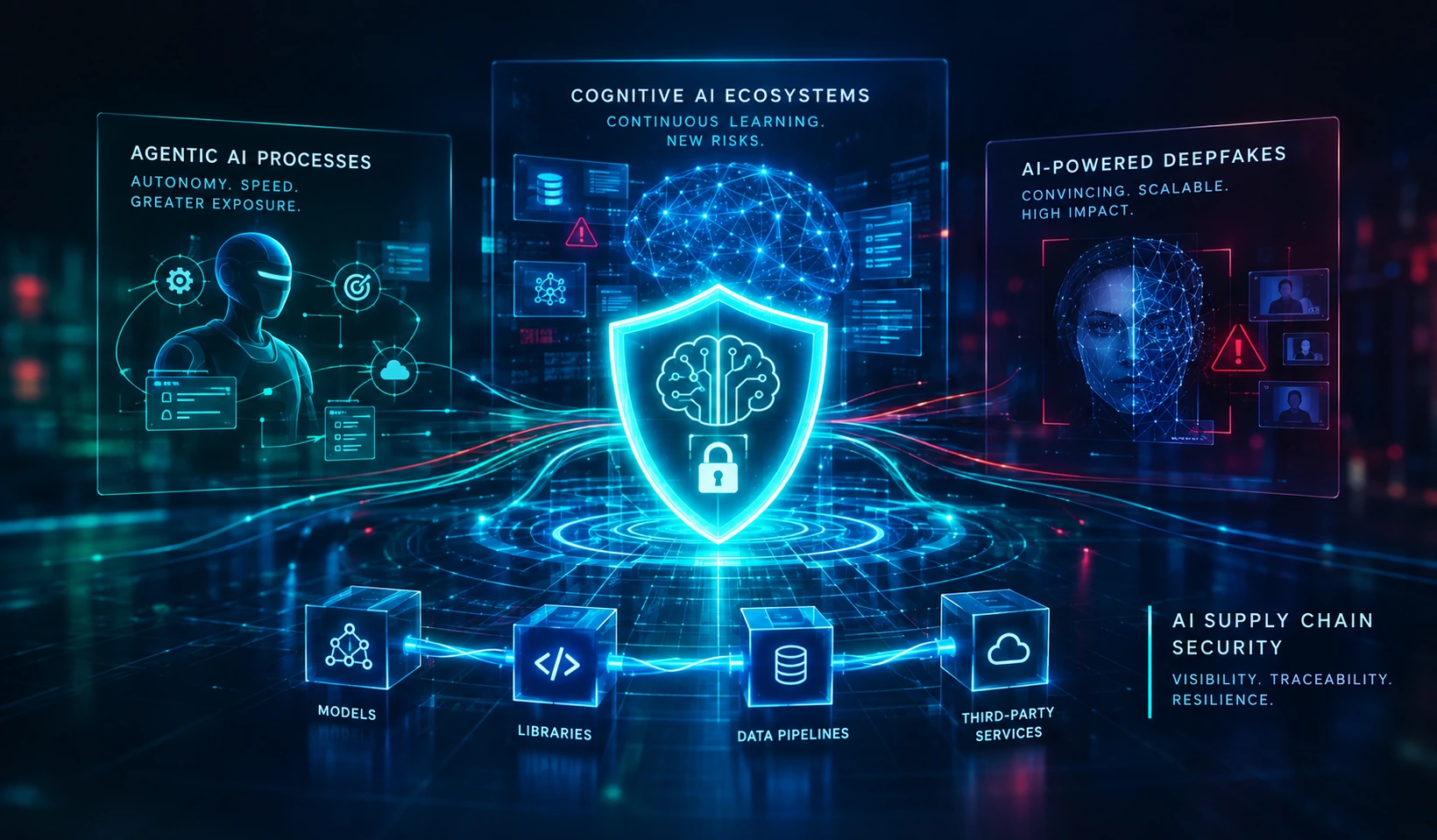
The transition from generative AI to more autonomous systems is currently underway, and there are particular risks associated with this development for businesses. In addition to addressing the amplifying role of supply chain risks, such as the use of Software Bills of Materials (SBOMs) for AI models, it is essential to examine three critical aspects of next-generation AI risk in this progression.
Protecting Agentic AI Processes: Going Beyond Generative Models
Resilient, goal-oriented systems that autonomously plan, adapt, use tools, and carry out tasks are known as agentic AI. These systems significantly reduce decision cycles in enterprise networks, cybersecurity, defense, and logistics, going far beyond generative models.
Authorization drift, excessive privileges, shadow deployments, and high-velocity actions are some examples of cyber dangers. A compromised agent has the ability to spread laterally at machine speed. Supply chain risks are particularly increased because interconnected models, third-party components, and Application Programming Interfaces (APIs) provide pathways for backdoor agents, poisoned data, and cascading failures.
An organization can provide transparency into components, dependencies, and potential vulnerabilities by creating and maintaining SBOMs for AI models. This allows for quick identification and remediation when problems occur in the model supply chain.
For instance, a company uses agentic AI to optimize its supply chain. Unnoticed without an SBOM, a hacked third-party library or tainted model component introduces a malicious agent that steals confidential information and discreetly modifies logistics choices, resulting in both operational interruption and intellectual property theft.
Suggestions:
- Treat agents as first-class identities with human-on-the-loop monitoring
- Apply dynamic least privilege and constant visibility
- Secure the whole supply chain with automated vulnerability scans and integrity checks
- Maintain SBOMs for AI models and components
- Conduct thorough vendor evaluations
Cognitive AI Ecosystems: Adapting to Dangers via Continuous-Learning Fabrics
Proactive Security Operations Centers (SOCs) are made possible by the transition to cognitive AI ecosystems that dynamically learn from threats. Malicious adaptive malware behaves differently from traditional, static malware, making it harder to detect using signature-based tools. Poisoned training data or compromised learning model updates can introduce supply chain risks. In order to identify tampering or supply chain compromises early on, SBOMs for AI models become crucial, recording the provenance of datasets, libraries, and foundation models.
Example: A tainted update from a vendor is ingested by a bank's cognitive threat detection system. The system starts downplaying specific attack patterns in the absence of an updated SBOM tracing the model component, allowing ongoing espionage until human analysts use behavioral drift to identify the anomaly.
Strategies:
- Maintain human oversight with ethical governance
- Enforce supply chain vetting, including SBOM criteria for all AI aspects
- Use coachable systems with ongoing pretraining
AI-Powered Deepfakes for Business Espionage
Sophisticated impersonation for espionage and phishing is made possible by deepfakes. When vendor tools, datasets, or models used to train synthetic media are compromised, supply chain risks exacerbate this threat. Integrity and traceability are enhanced by keeping SBOMs for any generative AI models used in media workflows.
For instance, attackers create a convincing video call requesting immediate fund transfers using deepfakes of executives that were trained on compromised data from a breached vendor pipeline, a supply chain vector, causing multimillion-dollar losses. Anomalous elements in the training pipeline might have been identified by an SBOM.
Chief Information Security Officer (CISO) tactics include:
- Supply chain due diligence, including SBOMs for AI technologies
- Simulations and tabletop exercises
- Multi-modal detection
- Secure internal environments
The Overall Dimension of the Supply Chain
AI supply chain threats are present in all of these domains; compromised models, libraries, data pipelines, or third-party services serve as force multipliers. Deepfake defenses, cognitive adaptation, or agentic autonomy can all be compromised by a single vulnerable dependency.
In order to map dependencies, trace provenance, and react quickly to new vulnerabilities or breaches, mitigation necessitates end-to-end visibility, zero-trust principles for components, frequent integrity scans, diverse sourcing, and widespread use of SBOMs specifically for AI models.
Businesses that prosper in this period will integrate strong identity controls, ongoing learning, defenses against synthetic media, and robust supply chain security, including SBOM procedures adapted to the opaque and quickly changing nature of AI models. Today's proactive stewardship creates the resilience we will need in the future.





.svg)
See Cybeats Security Platform in Action Today
We shortened our vulnerability review timeframe from a day to under an hour. It is our go-to tool and we now know where to focus our limited security resources next.
.svg)

SBOM Studio saves us approximately 500 hours per project on vulnerability analysis and prioritization for open-source projects.


