LAST UPDATED 13 SEPTEMBER 2026

EU CRA SBOM Requirements

Under the EU Cyber Resilience Act, Regulation (EU) 2024/2847, every product with digital elements sold in the EU must ship with a software bill of materials covering at least its top-level dependencies. It goes to market surveillance authorities on reasoned request, not to the public. BSI TR-03183-2 v2.1.0 sets the baseline: CycloneDX 1.6 or SPDX 3.0.1 or higher, in JSON or XML.
Article 14 reporting of actively exploited vulnerabilities and severe incidents started 11 September 2026. The SBOM obligation applies from 11 December 2027.

When do the EU CRA SBOM and reporting obligations apply?

10 December 2024

Entered into force
The CRA entered into force on the twentieth day after publication in the Official Journal, under Article 71(1). Every transitional period runs from this date. Chapter IV, covering conformity assessment bodies, applied earlier than the rest, from 11 June 2026.

11 September 2026

Reporting started (Article 14)
Actively exploited vulnerabilities and severe incidents must be reported through the ENISA Single Reporting Platform. Article 69(3) extends this to all products placed on the market before 11 December 2027, whether or not they are ever modified.

11 December 2027

Full application (Annex I)
Essential cybersecurity requirements, the SBOM obligation in Annex I Part II, conformity assessment and CE marking all apply. Under Article 69(2), products already on the market come into scope only if they undergo a substantial modification from this date.

What must an EU CRA SBOM contain?

The CRA itself names no format. Annex I Part II point (1) requires an SBOM in a commonly used, machine-readable format covering at least the top-level dependencies of the product, and Article 13(24) lets the Commission specify the format and elements later through implementing acts. Until it does, Germany's BSI TR-03183-2 is the most concrete published baseline in the EU. Version 2.1.0 accepts CycloneDX 1.6 or higher and SPDX 3.0.1 or higher, serialised as JSON or XML, and only in officially released versions of those specifications.

One rule catches people out: an SBOM must not carry vulnerability information. BSI TR-03183-2 keeps the two apart, because an SBOM describes a fixed software composition while vulnerability status changes constantly. Vulnerability data belongs in CSAF or VEX documents that reference the SBOM. For the same reason, a separate SBOM is required for every version of a product.

BSI TR-03183-2 v2.1.0 data fields
Data fieldStatusWhat it must carry
Creator of the SBOMRequired, SBOM levelEmail address of the entity that created the SBOM, or a URL such as the creator's home page if no email address exists.
TimestampRequired, SBOM levelDate and time the SBOM data was compiled. BSI recommends UTC, or Zulu time.
SBOM-URIAdditional, SBOM levelThe URI of the SBOM itself.
Component creatorRequiredEmail address of the entity that created and, where applicable, still maintains the component, or a URL if no email address exists.
Component nameRequiredThe name the component creator assigned. If no name was assigned, the actual filename.
Component versionRequiredThe creator's version identifier. Semantic or calendar versioning should be used. If no version exists, the file modification date as an RFC 3339 date-time.
Filename of the componentRequiredThe actual filename, not its file system path.
Dependencies on other componentsRequiredEvery component this one directly depends on or contains. The completeness of that list must be clearly indicated.
Distribution licencesRequiredThe licence or licences under which a licensee may use the component.
Hash value of the deployable componentRequiredA SHA-512 checksum of the component in its deployed or deployable form, as a file on storage.
Executable propertyRequiredEither executable or non-executable.
Archive propertyRequiredEither archive or no archive.
Structured propertyRequiredEither structured or unstructured. A component with both kinds of part must be recorded as structured.
Source code URIAdditionalThe URI of the component's source code, ideally the exact version used in its repository.
URI of the deployable formAdditionalA URI pointing directly at the deployable, for example downloadable, form of the component.
Other unique identifiersAdditionalIdentifiers for looking the component up elsewhere, such as Common Platform Enumeration (CPE) or Package URL (purl).
Original licencesAdditionalThe licences assigned by the component's creator, as distinct from the distribution licences.
Effective licenceOptionalThe licence under which the creator of this SBOM actually uses the component.
Hash value of the source codeOptionalA checksum of the component's source code. BSI notes that no algorithm for hashing a source tree has been fixed yet.
URL of the security.txtOptionalThe location of the component creator's security.txt, per RFC 9116.

Required means the field must always be present. Additional means it must be provided whenever it exists and the chosen format supports it. Optional means it may be included. Where information genuinely cannot exist, for example the filename or hash of a component that is never deployed as a separate file, BSI allows it to be omitted.

Source: BSI TR-03183-2, Cyber Resilience Requirements for Manufacturers and Products, Part 2: Software Bill of Materials, version 2.1.0, 20 August 2025.

What must you report under Article 14, and how fast?

Article 14 creates two separate reporting duties with two separate clocks. Both are filed through the single reporting platform that ENISA operates under Article 16, and both go simultaneously to the CSIRT designated as coordinator and to ENISA. Article 14(7) routes the report to the CSIRT of the member state where you have your main establishment in the Union, meaning the state where decisions about the cybersecurity of your products are predominantly taken.
Actively exploited vulnerability
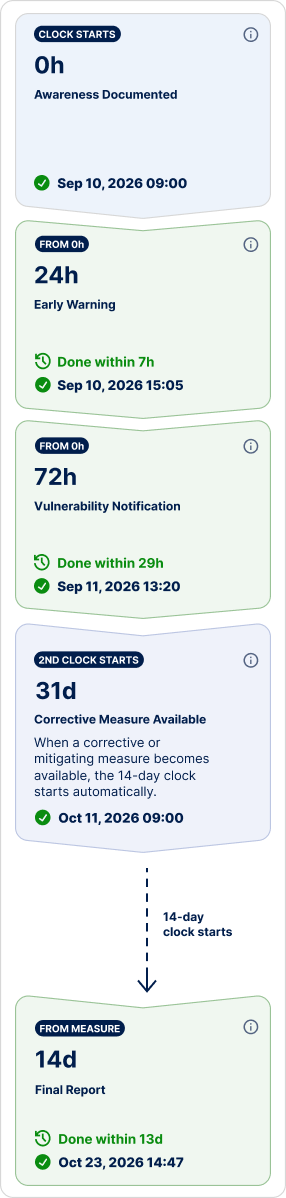
Article 14(1) and (2). An early warning within 24 hours of becoming aware, a fuller vulnerability notification within 72 hours, then a final report no later than 14 days after a corrective or mitigating measure is available.
Severe incident
Article 14(3) and (4). The same 24 hour and 72 hour steps, but the final report is due within one month of the 72 hour notification, not 14 days. Article 14(5) defines severe: the incident affects, or could affect, the product's ability to protect availability, authenticity, integrity or confidentiality, or it could lead to malicious code running in the product or in a user's systems.
No main establishment in the EU
Article 14(7) sets a fallback order: the member state of your authorised representative, then your importer, then your distributor, then wherever most of your users are. Once you have reported to a CSIRT chosen on that last rule, you may keep reporting to the same one.
Article 14 reporting clock
StepActively exploited vulnerability (Article 14(2))Severe incident (Article 14(4))
Early warningWithin 24 hours of becoming awareWithin 24 hours of becoming aware
NotificationWithin 72 hours of becoming aware. Covers the general nature of the exploit and the vulnerability, corrective or mitigating measures taken, and measures users can take.Within 72 hours of becoming aware. Covers the nature of the incident, an initial assessment, corrective or mitigating measures taken, and measures users can take.
Final reportNo later than 14 days after a corrective or mitigating measure is available.Within one month of submitting the 72 hour notification. This is the deadline most summaries get wrong by copying the 14 day figure across.
Intermediate reportOnly if the coordinating CSIRT requests one, under Article 14(6).Only if the coordinating CSIRT requests one, under Article 14(6).
Telling usersRequired under Article 14(8), where appropriate in a structured, machine-readable format.Required under Article 14(8), where appropriate in a structured, machine-readable format.

Built for the teams carrying the risk.

Product Security Officers, CSOs, and product security and governance leaders are the ones accountable when a CRA deadline is missed. SBOM Studio gives them one governed SBOM System of Record and Article 14 reports ready to file, whether they're headquartered in the EU or selling into it.

Manufacturing
& Industrial

OT systems, industrial controllers, and connected equipment sold or deployed across the EU.

Internet of Things (IoT)

Connected consumer and industrial devices, often the least inventoried products in a portfolio.

Telecom &
Networking

Network infrastructure and communications equipment with long field-support periods.

Software &
Technology Vendors

Standalone software and platform providers now facing a legal, not just best-practice, SBOM requirement.

Automotive

Type-approved vehicles are excluded under 2019/2144. Aftermarket and non-type-approved components fall under the CRA.

Medical Devices

Devices fall under MDR and IVDR. Companion apps and non-device software fall under the CRA. All require an SBOM.

How do you prepare for the EU CRA SBOM and reporting obligations?

Which CRA article creates which obligation?

The SBOM and reporting duties are spread across the annexes and the articles, and they do not all start on the same day. This is the map.

Regulation (EU) 2024/2847, provision to obligation
ProvisionWhat it requiresApplies from
Article 14(1) and (2)Report an actively exploited vulnerability: early warning within 24 hours, vulnerability notification within 72 hours, final report within 14 days of a fix being available.11 September 2026
Article 14(3) and (4)Report a severe incident: early warning within 24 hours, incident notification within 72 hours, final report within one month of that notification.11 September 2026
Article 14(7)File through the notification end-point of the CSIRT designated as coordinator in your member state of main establishment, accessible to ENISA at the same time.11 September 2026
Article 14(8)Inform impacted users of the vulnerability or incident and any mitigation they can apply, where appropriate in a structured, machine-readable format that is easily automatically processable. The CRA names no format. BSI TR-03183-3 points to OASIS CSAF 2.0, standardised as ISO/IEC 20153:2025.11 September 2026
Article 16ENISA establishes and operates the single reporting platform. The receiving CSIRT disseminates the notification to other coordinators, and may delay that on justified cybersecurity grounds.11 September 2026
Article 69(3)By way of derogation from Article 69(2), the Article 14 reporting duties apply to every in-scope product placed on the market before 11 December 2027, whether or not it is ever substantially modified.11 September 2026
Annex I, Part II, point (1)Identify and document vulnerabilities and components, including by drawing up an SBOM in a commonly used, machine-readable format covering at least the top-level dependencies of the product.11 December 2027
Annex VII, point 8Hold the SBOM as part of the technical documentation and supply it further to a reasoned request from a market surveillance authority. There is no duty to publish it.11 December 2027
Annex II, point 9If you choose to make the SBOM available to users, the product information must say where they can access it.11 December 2027
Article 13(25)Market surveillance authorities may request SBOMs for a Union-wide software dependency assessment decided by ADCO, reported on in anonymised, aggregated form.11 December 2027
Article 24(3)Open source software stewards carry the Article 14(1) duty where they are involved in developing the product, and Article 14(3) and (8) where a severe incident affects the systems they provide for that development.11 December 2027
Article 13(24)The Commission may specify the format and elements of the SBOM by implementing act, taking European and international standards into account. No such act has been adopted.Not yet exercised

What are the penalties under the EU CRA?

Article 64 sets ceilings, and each member state lays down its own rules within them. Missing the SBOM obligation sits in the highest tier, alongside the Article 14 reporting duties.

Article 64 administrative fine ceilings
What was breachedMaximum fineBasis
The Annex I essential requirements, Article 13, or Article 14EUR 15 000 000, or 2,5 % of total worldwide annual turnover for the preceding financial year, whichever is higher.Article 64(2)
Duties on importers, distributors, notified bodies and related obligationsEUR 10 000 000, or 2 % of total worldwide annual turnover, whichever is higher. Covers Articles 18 to 23, 28, 30(1) to (4), 31(1) to (4), 32(1) to (3), 33(5), 39, 41, 47, 49 and 53.Article 64(3)
Incorrect, incomplete or misleading information given to a notified body or market surveillance authorityEUR 5 000 000, or 1 % of total worldwide annual turnover, whichever is higher.Article 64(4)
A microenterprise or small enterprise that misses the 24 hour early warningThe fines in Article 64(3) to (9) do not apply to that missed deadline under Article 14(2)(a) or 14(4)(a).Article 64(10)(a)
An open source software steward, for any infringementThe fines in Article 64(3) to (9) do not apply.Article 64(10)(b)

Member states set the actual rules under Article 64(1); the figures above are the ceilings the CRA fixes. Article 64(5) requires regard to the nature, gravity and duration of the infringement, whether fines have already been applied to the same operator for something similar, and the size and market share of the operator, with microenterprises and SMEs named specifically.

How software makers meet the 24 hour clock in practice
The EU Cyber Resilience Act's technical requirements come down to two things, on two dates: Article 14 reporting from September 11, 2026, and a governed SBOM System of Record under Annex I from December 11, 2027.

SBOM Studio · System of Record

Most teams have SBOMs scattered across build pipelines, spreadsheets, and vendor emails. SBOM Studio unifies component- and project-level SBOMs into one governed product SBOM, in the machine-readable formats regulators require. It's continuously maintained across your portfolio and matched against live vulnerability data.

A governed product SBOM satisfies Annex I, Part II(1) of the CRA, which applies from December 11, 2027, and it's what a market surveillance authority can request while your product is supported.
CycloneDX
SPDX
EU CRA Annex I
BSI TR-03183-2
CISA 2026 Minimum Elements
Explore SBOM Studio

Raven · Add-on

Raven confirms whether the vulnerable path can execute in your build, returns a reasoned VEX statement, and lands the evidence in your audit trail. That's how you report inside 24 hours.
Explore Raven
Raven, the AI intelligence layer add-on to SBOM Studio
BE READY BY SEPTEMBER 11, 2026

SBOM Studio Prepares Your Article 14 Report

Article 14 of the EU Cyber Resilience Act requires manufacturers to notify ENISA and their national CSIRT of an actively exploited vulnerability within 24 hours of becoming aware of it.

SBOM Studio continuously matches every component in your SBOM against threat intelligence, KEV listings, exploitation markers, and patch status. It flags a vulnerability only on reliable evidence of malicious exploitation in your product, not a theoretical weakness or exploitation elsewhere. That moment of awareness starts your Article 14 clock, and SBOM Studio begins your reporting workflow immediately.

Your report is mapped field-for-field to the ENISA Single Reporting Platform (SRP), pre-assembled and ready for you to review and file, not drafted from scratch.

Article 14 also covers severe incidents affecting product security, on a separate clock. This feature covers Actively Exploited Vulnerabilities (AEV).
Decorative graphic
Book a Demo

Which other regulations require an SBOM?

The EU CRA, EU MDR, FDA section 524B, IEC 62443, NIS2, ISO/SAE 21434 and the 2026 CISA SBOM Minimum Elements all ask for the same underlying thing: a component inventory you can prove. The Cybeats regulations tracker maps SBOM and vulnerability management requirements across industries and jurisdictions, filterable by country and sector, with links to the official sources.
Explore the Regulations Tracker
EU CRA Glossary

Software Bill of Materials

A software bill of materials (SBOM) is a machine-readable inventory of the components in a product, typically in CycloneDX or SPDX format. It's the foundation that the CRA's reporting and disclosure obligations sit on.

Actively exploited vulnerability

An actively exploited vulnerability is a vulnerability with reliable evidence of exploitation in the wild against a specific product. Under the CRA, this is the trigger that starts the 24-hour Article 14 reporting clock.

Cyber Resilience Act

The Cyber Resilience Act, Regulation (EU) 2024/2847, is the EU's horizontal cybersecurity law for products with digital elements, covering secure-by-design, SBOM, and vulnerability reporting obligations.

SBOM System of Record

An SBOM System of Record is the single, governed, audit-ready source of truth for every SBOM across a product portfolio, matched continuously against vulnerability data. Distinct from a generation tool, which describes one build, or a repository, which stores files.

Article 14 reporting

Article 14 is the CRA provision requiring manufacturers to report actively exploited vulnerabilities and severe incidents to ENISA and their national CSIRT, from September 11, 2026. Early warning within 24 hours, detailed notification within 72 hours, final report within 14 days of a corrective or mitigating measure becoming available. Severe incidents follow a separate clock, with a final report within one month.

CE marking

CE marking is the conformity mark confirming a product meets CRA requirements before it can be placed on the EU market.

EU CRA SBOM requirements: frequently asked questions

Does the EU CRA require an SBOM?

Yes. Annex I Part II point (1) requires manufacturers to identify and document vulnerabilities and components, including by drawing up a software bill of materials in a commonly used, machine-readable format covering at the very least the top-level dependencies of the product. It applies from 11 December 2027.

What format must an EU CRA SBOM be in?

The CRA says only commonly used and machine-readable. Article 13(24) lets the Commission fix the format and elements by implementing act, and no such act has been adopted. The working reference point in the EU is BSI TR-03183-2 v2.1.0, which accepts CycloneDX 1.6 or higher and SPDX 3.0.1 or higher, serialised as JSON or XML, in officially released versions only.

How deep does an EU CRA SBOM have to go?

The CRA sets a floor, not a ceiling: at the very least the top-level dependencies. BSI TR-03183-2 goes further, resolving dependencies along each path down to and including the first component outside the scope of delivery.

Do you have to publish your SBOM under the EU CRA?

No. Annex VII point 8 puts the SBOM in the technical documentation, to be supplied further to a reasoned request from a market surveillance authority. Annex II point 9 adds only that if you choose to make the SBOM available to users, you must tell them where to access it.

Can an EU CRA SBOM contain vulnerability information?

It should not. BSI TR-03183-2 keeps vulnerability information out of the SBOM, because an SBOM describes a fixed software composition while vulnerability status changes constantly. Vulnerability data belongs in CSAF or VEX documents that reference the SBOM.

Do you need a separate SBOM for every product version?

Yes. BSI TR-03183-2 requires one SBOM per version of a software product, which is also what makes the Article 14 question, are we affected, answerable in minutes.

What is Article 14 of the EU CRA?

The reporting provision, and it creates two duties with two clocks. For an actively exploited vulnerability: an early warning within 24 hours, a vulnerability notification within 72 hours, and a final report no later than 14 days after a corrective or mitigating measure is available. For a severe incident: the same 24 and 72 hour steps, but the final report is due within one month of the 72 hour notification.

When does EU CRA reporting start?

11 September 2026. From that date, actively exploited vulnerabilities and severe incidents are filed through the single reporting platform ENISA operates under Article 16, going simultaneously to ENISA and to the CSIRT designated as coordinator in your member state of main establishment.

Does the EU CRA apply to products already on the market?

For reporting, yes. Article 69(2) would otherwise bring older products into scope only on a substantial modification, but Article 69(3) derogates from that: the Article 14 duties apply to every in-scope product placed on the market before 11 December 2027, modified or not.

Does the EU CRA apply if you are not based in the EU?

Yes. It follows where the product is made available, not where the company sits. Manufacturers, importers and distributors of products with digital elements placed on the EU market all carry obligations. If you have no main establishment in the Union, Article 14(7) sets a fallback order for which CSIRT you report to: your authorised representative's member state, then your importer's, then your distributor's, then wherever most of your users are.

What are the penalties for EU CRA non-compliance?

Article 64(2) sets the top tier for breaching the Annex I essential requirements, Article 13 or Article 14: up to EUR 15 000 000 or 2,5 % of total worldwide annual turnover for the preceding financial year, whichever is higher. Lower ceilings of EUR 10 000 000 or 2 %, and EUR 5 000 000 or 1 %, apply to other obligations. Member states lay down the actual rules, so confirm your exposure with counsel.

How is SBOM Studio different from a generic SBOM generator?

Generation is one step. SBOM Studio pairs it with continuous vulnerability monitoring and an Article 14 reporting workflow mapped field for field to the ENISA single reporting platform, so it acts as an ongoing SBOM system of record rather than a one-time export.

Does an SBOM system of record help beyond the EU CRA?

Yes. The same governed inventory, continuous monitoring and VEX generation that satisfy the CRA also support FDA section 524B, IEC 62443 and other frameworks, so CRA readiness builds on infrastructure you can reuse.