

.svg)
.svg)
 Investors Inquiry
Request a Demo

Download Product Brochure
Download Cybeats Marketplace Brochure
AI Bill of Materials (AIBOM): The Complete Guide

What is an AIBOM?
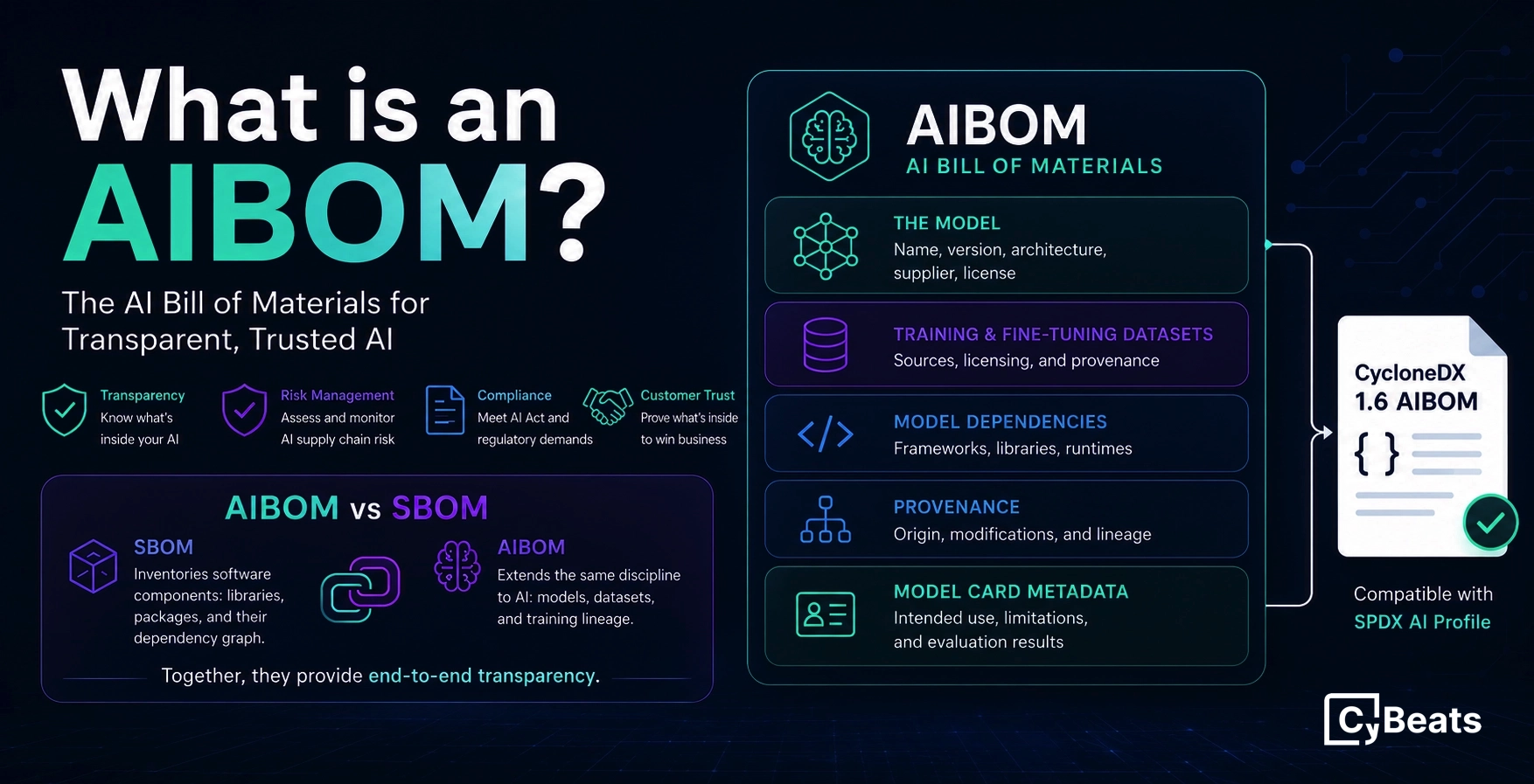
An AI Bill of Materials (AIBOM) is a structured, machine readable inventory of everything inside an AI system: the model itself, the datasets used to train and fine tune it, the software dependencies that serve it, and the provenance of each component. Where an SBOM answers what is in this software, an AIBOM answers what is in this AI, giving security teams, regulators, and customers the transparency they need to trust AI systems.
Why AIBOMs matter now
Three forces are turning AIBOMs from a research topic into a requirement. First, regulation: the EU Artificial Intelligence Act (Regulation (EU) 2024/1689) imposes transparency and technical documentation obligations on AI providers, and recent US White House AI directives, including America's AI Action Plan and the 2026 Executive Order on Promoting Advanced Artificial Intelligence Innovation and Security, push the same expectations into federal procurement. Second, supply chain risk: organizations increasingly build on open models and third party datasets they did not create and cannot see inside. Third, customer trust: enterprise buyers have started asking AI vendors the same question they ask software vendors, which is show me what is inside.
What goes into an AIBOM
- The model: name, version, architecture, supplier, and license
- Training and fine tuning datasets, with sources and licensing
- Model dependencies: frameworks, libraries, and runtimes that serve the model
- Provenance: where the model came from, who modified it, and how
- Model card metadata: intended use, limitations, and evaluation results
The OWASP AIBOM work aligns with CycloneDX 1.6 and 1.7and is compatible with the SPDX AI Profile, so AIBOMs travel through the same tooling ecosystems as SBOMs.
AIBOM vs SBOM: what is the difference?
An SBOM inventories software components: libraries, packages, and their dependency graph. An AIBOM extends the same discipline to AI systems, adding the artifacts that make AI different: models, datasets, and training lineage. In practice the two work together. Every AI system runs on software, so a complete transparency picture pairs the AIBOM for the AI layer with the SBOM for the software stack underneath it.
How to generate an AIBOM
The OWASP AIBOM Generator, an open source tool under the OWASP GenAI Security Project, generates AIBOMs from models hosted on Hugging Face. It extracts metadata from model cards, configurations, and repository files, produces a CycloneDX 1.6 AIBOM, and scores its completeness with concrete improvement recommendations. The tool is listed in the CycloneDX Tool Center and available live at owasp-genai-aibom.org. I maintain the generator together with the OWASP AIBOM Initiative community, which anyone can join.
Managing AIBOMs at scale
Generating an AIBOM is step one. The operational work starts after: keeping AIBOMs current as models are retrained or swapped, monitoring the software stack behind every model for new vulnerabilities, proving transparency to customers and regulators, and doing this across a portfolio rather than a single model. That lifecycle is what Cybeats SBOM Studio manages. It ingests AIBOMs in CycloneDX or SPDX format, including those created with the OWASP AIBOM Generator, catalogs AI models and datasets alongside software, cryptographic, and hardware components, and provides continuous vulnerability monitoring, metadata enrichment, and secure sharing, including over the Transparency Exchange API.
Frequently asked questions
What is an AI Bill of Materials (AIBOM)?
An AIBOM is a machine readable inventory of an AI system's components: the model, its training and fine tuning datasets, its software dependencies, and their provenance and licenses. It extends the SBOM concept to AI so organizations can assess, monitor, and prove what is inside the AI they build and buy.
What format is an AIBOM written in?
The leading format is OWASP CycloneDX 1.6, which added first class support for machine learning components. The SPDX AI Profile is compatible, and tools like the OWASP AIBOM Generator produce CycloneDX 1.6 output that works with existing SBOM tooling.
Does the EU AI Act require an AIBOM?
The EU Artificial Intelligence Act (Regulation (EU) 2024/1689) requires providers of high risk AI systems to maintain technical documentation covering the system's elements, data, and development process. An AIBOM is the practical, machine readable way to produce and maintain that evidence, the same way SBOMs became the practical answer to software transparency mandates.
How do I create an AIBOM for a Hugging Face model?
Use the OWASP AIBOM Generator at owasp-genai-aibom.org: paste the model ID and it extracts the metadata, generates a CycloneDX 1.6 AIBOM, and scores its completeness. The tool is open source under Apache 2.0 and also runs from the command line or via API for automation.
Who is behind the OWASP AIBOM Initiative?
The initiative runs under the OWASP GenAI Security Project and is co-led by Helen Oakley and Dmitry Raidman, Cybeats CTO and co-founder. It maintains the AIBOM Generator and works on making AI transparency practical, with participation open to the community.
Operationalize your AIBOMs
Generate AIBOMs with the OWASP AIBOM Generator, then manage them through their lifecycle with SBOM Studio.






.svg)
See Cybeats Security Platform in Action Today
We shortened our vulnerability review timeframe from a day to under an hour. It is our go-to tool and we now know where to focus our limited security resources next.
.svg)

SBOM Studio saves us approximately 500 hours per project on vulnerability analysis and prioritization for open-source projects.


